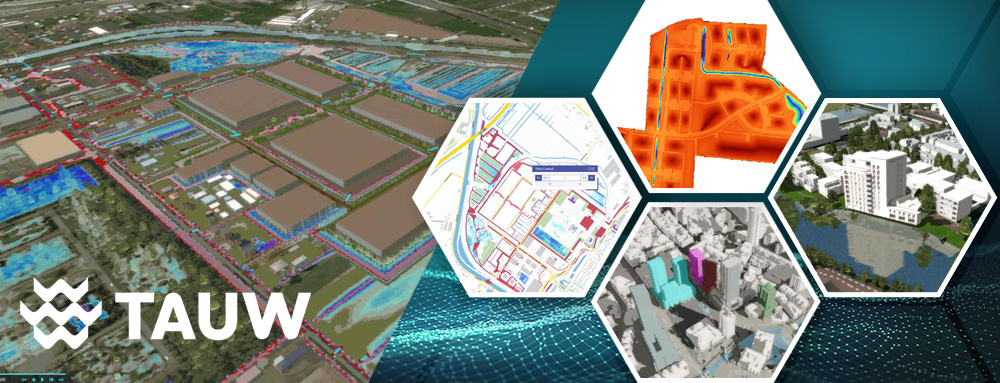
The annual Tygron Community of Practice took place this year on November 11th. This meeting is by and for users: a moment where knowledge, experience, skills, applications, and the latest technological developments converge. During the CoP, several Tygron users, including engineers from TAUW, shared their experiences using the platform.
Climate adaptation requires smart solutions that are both effective and efficient. Ruben Keizer and Len Geisler of TAUW Consultancy and Engineering demonstrate how data-driven design using Tygron can accelerate and improve the process of climate-resilient urban projects.
“Today, we’re going to take you through the climate design challenges we encounter at TAUW,” begins Ruben Keizer. He emphasizes that the challenges in climate-resilient design are often similar and that a standardized approach ensures efficiency. However, there’s still plenty of room for customization. “Very often still very project-based, but we’ve now created a fully standardized approach for that as well.” It’s crucial that both work processes and tools are designed to simplify knowledge sharing between parties and to enable iterative designs to produce results more quickly.
Iterative process
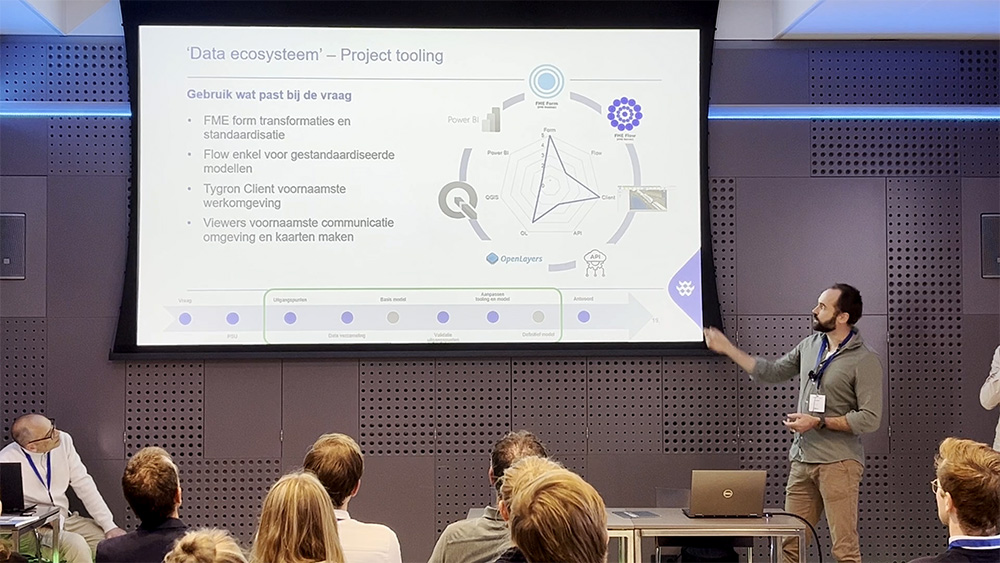
TAUW has established a complete web-based network of tools connected via APIs and connectors. “We’ve essentially built an ecosystem of different tools, each with its own place, to answer complex questions,” says Len Geisler. From FME for advanced analyses to Tygron’s 3D client and various viewers for interpretation and communication, everything is designed for flexible and efficient working. Geisler emphasizes the practical benefit: “It’s incredibly helpful with quality assurance and validation, but also for having the right models in place and being able to share results quickly with clients.”
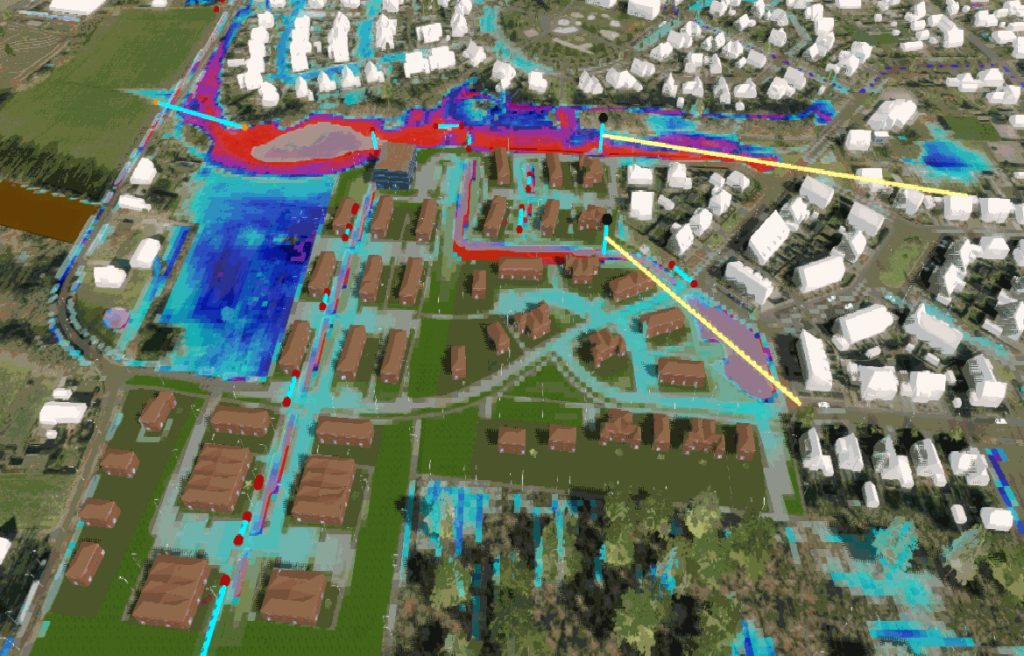
Keizer demonstrates how data from existing infrastructure, such as roads and waterways, is combined with project data from CAD files of designs (SO, VO, and DO). This allows for the creation of both 2D and 3D representations that can be used for further analyses. For example, converted elevation data into a new ground level model for flooding analyses, or converted 3D designs for heat stress calculations. Crucially, the process is iterative and supports both policymakers and designers: “We’re noticing that there’s increasing interest from the design side, from project managers, to apply this in projects themselves,” says Keizer.
Standardization and Flexibility
The duo also discussed the various levels of design information provided, ranging from sketches to advanced BIM models via the Autodesk Construction Cloud. “As soon as a designer is finished in their BIM environment and we know they’re up to date, we can hit refresh and a new design is immediately added to the project area.” This enables truly iterative work, where a design cycle can be completed ten times with relative ease.
Geisler then elaborated on the analysis tools: “One example is working with FME-server.” This makes it possible to quickly and reliably assess climate factors such as heat, shade, and flooding in the design using standard models. The combination of standardization and flexibility makes the process scalable, from small redevelopments to larger urban projects.