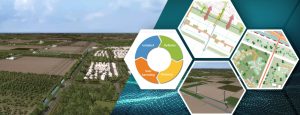
The annual Tygron Community of Practice took place this year on November 11th. This meeting is by and for users: a moment where knowledge, experience, skills, applications, and the latest technological developments come together. During the CoP, various Tygron users, including employees of the Municipality of Amsterdam, shared their experiences using the platform.
Urban heat is a structural challenge and demands policy adjustments. Clara Keuken and Tom Remijn, water and climate adaptation consultants at Ingenieursbureau Amsterdam, will explain at the Tygron user day how they approach heat stress analyses in the capital. “We expect more and more heat policy, because it’s lagging behind water policy,” Remijn explains. “That’s why we’re now looking at where we can standardize our work, making it faster and less prone to errors, so we can respond to this increasing demand.”
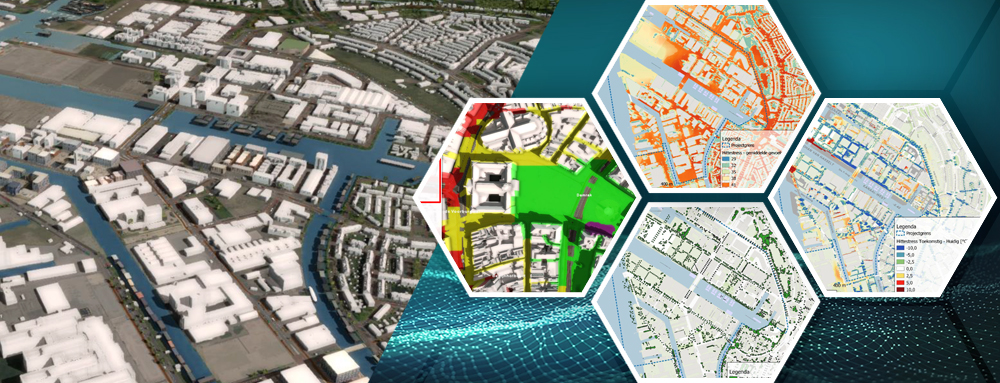
The policy isn’t yet law, but a letter of intent has been signed with the Metropolitan Region. Two rules are central: every Amsterdam resident must have a cool spot within three hundred meters (at least 200m² of shade and a perceived temperature below 35 degrees Celsius), and there must be 40% shade on walking and cycling routes. “That’s the so-called ‘slipper distance,'” says Remijn. “No official policy means we have no stick to beat around the bush with, but especially with large projects, everyone is very willing to cooperate.”
Automated workflow
Tygron is used for large-scale area developments where design freedom and impact are significant. There was a need to automate the manual loading, unloading, and conversion of data, which was quite error-prone.
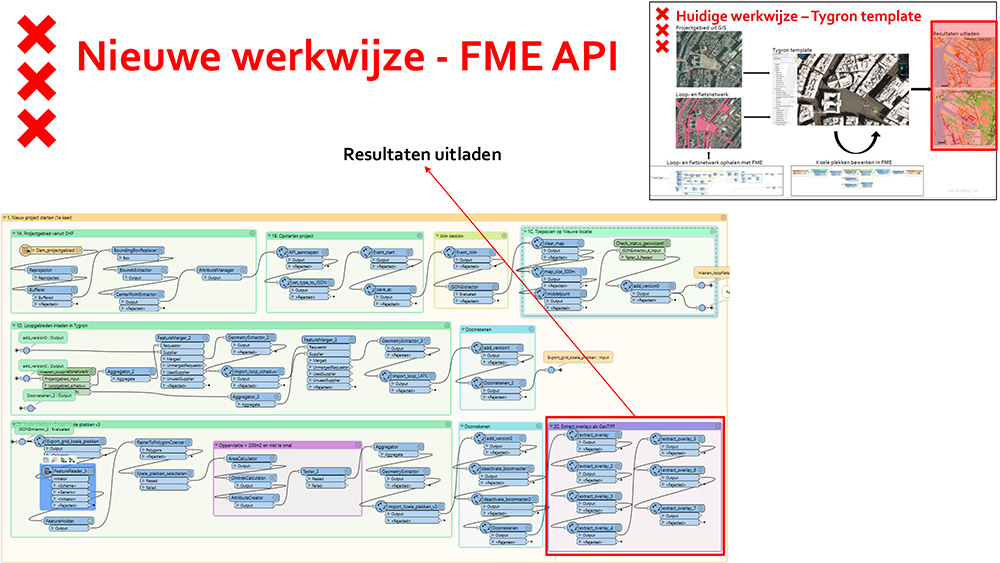
The consultants found the solution in an FME script that automates the entire workflow. “The template handles starting Tygron, calculating within the platform, and unloading all the Tygron maps we want to use all at once,” explains Clara Keuken. Input is minimal: only the project area, a password, and the storage location. The result is radically faster processing. The advantage of the new, fully automated approach is clear: “One click of a button and you can get coffee or check your email,” says Keuken. Then, with a laugh: “But I’d rather go get coffee.”
Data Standardization
In Buiksloterham, they demonstrate the benefits of this. A former industrial estate is being transformed into a residential and commercial area. The current situation has virtually no cool spots. In the new situation, additional trees will be planted, making coolness available within 300 meters of almost the entire area. Difference maps mercilessly reveal the last remaining warm spots, for example, near the ferry landing. “A lot of people stay there during the day,” says Remijn, “so it’s good that we now have that in view.”
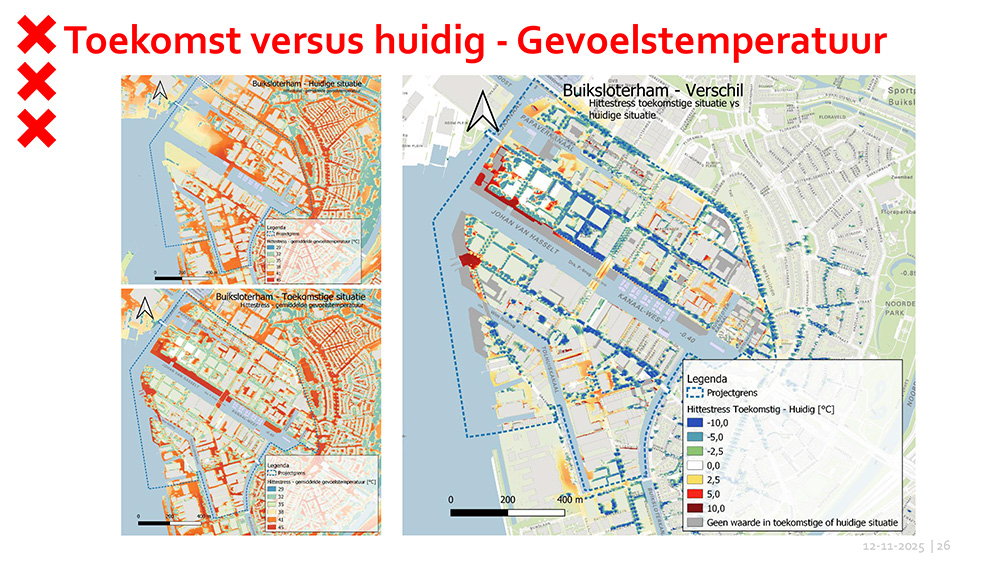
Still, not everything has been resolved. For large new construction projects, it still takes hours to get designs Tygron-ready. “We often spend hours working on it,” says Keuken, “to the point where sometimes it just doesn’t work.” The goal is to standardize the delivery of data, including from designers, so that more time is available for genuine advice.
“So we spend less time on those small tasks, can perform calculations faster, and can spend more time together improving the design.”
Future
Amsterdam’s future plans focus on conducting a new city-wide heat study to proactively identify bottlenecks. “We are also working with Tygron to explore using the AI suite to map treetops using image recognition,” says Keuken. Ultimately, Remijn concludes that the process and steps—the FME workflow and analysis methodology—are certainly applicable to other cities and municipalities.
Tygron Platform 2026:
Users’ desire to easily load urban development plans into the Tygron Platform is widely shared. This is also evident from the discussion that followed the presentation. The good news is that the Tygron Platform 2026 offers a large number of new functionalities to support this loading process more effectively and easily.
Although the Tygron Platform 2026 offers a large number of new functionalities for easily loading urban development plans, not everything has been resolved yet. Users’ desire – as is also evident in Amsterdam – goes beyond simply being able to load them technically. It calls for a working method in which automatic processing truly aligns with daily practice.
The new capabilities are therefore an important step forward, but at the same time demonstrate where further development remains necessary: aligning plans, data, and processes even more effectively, so that loading urban development plans is not only technically feasible but also fits seamlessly into the working methods of municipalities and other users.
Are you interested in the latest features for loading urban development plans and the Tygron AI Suite? Then register for one of our webinars.