Case
Control over growth in Deventer
Case
Control over growth in Deventer

Deventer is growing rapidly, but wants to maintain its quality of life and be able to substantiate the right choices. Read how a digital city model using Tygron helps the municipality make future developments visible and manageable.
Customer
Municipality of Deventer
Themes
Urban Development
Residential construction
Services
Consultancy

Challenge
Strong growth ambitions
Deventer has strong growth ambitions. Not only in terms of population size, but also in its ambitions for broad prosperity. Margriet Achtereekte, Lead of the Spatial Planning Vision for the municipality of Deventer, outlined the dilemma during the Tygron CoP in October 2025: "The total of the land demand is much more than the area that Deventer has available." There are therefore significant challenges ahead. Deventer wants to build 11,000 homes by 2035, and there is also a need for a new business park, substantial investments in the energy infrastructure are required, and there is also the greening challenge.
Challenge
Strong growth ambitions
Deventer has strong growth ambitions. Not only in terms of population size, but also in its ambitions for broad prosperity. Margriet Achtereekte, Lead of the Spatial Planning Vision for the municipality of Deventer, outlined the dilemma during the Tygron CoP in October 2025: "The total of the land demand is much more than the area that Deventer has available." There are therefore significant challenges ahead. Deventer wants to build 11,000 homes by 2035, and there is also a need for a new business park, substantial investments in the energy infrastructure are required, and there is also the greening challenge.
Approach
Digital twin of the municipality brings a solution
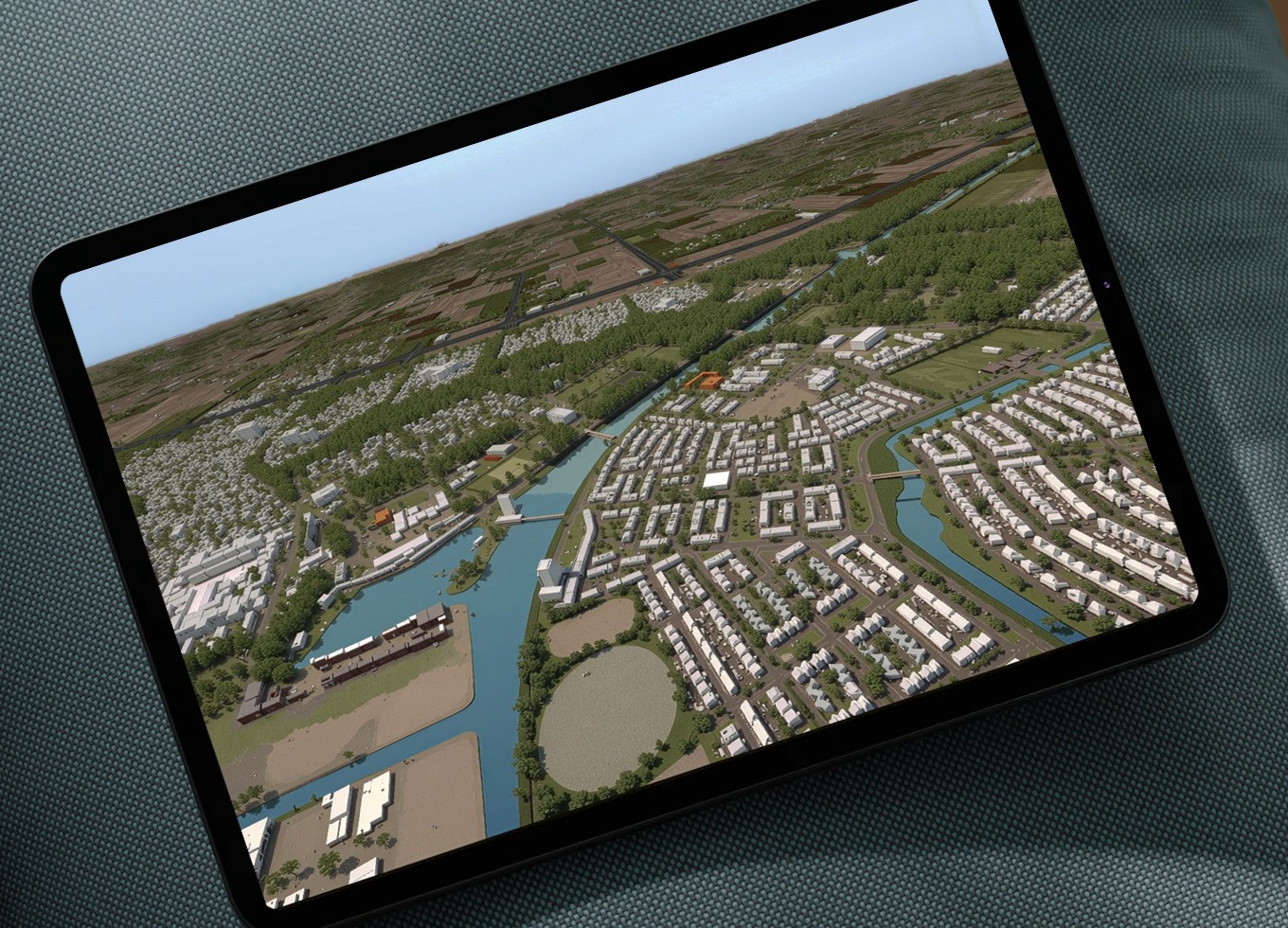
"We started testing digital tools to get a grip on our growth," says colleague Gijs Schulkes, Coordinator of the Geo-information department of the municipality of Deventer. The challenge is to make smart choices that unite mobility, livability, and climate adaptation within the constraints of limited space. A digital twin of the municipality provided a solution. Not so much as the solution to all problems, but as a strategic tool to make future developments insightful and therefore manageable. It was a bit of a gamble, Achtereekte admits. "We said to each other, we have three months." Three months to use a digital twin to prove that you can add housing in Deventer within the existing urban area while strengthening green spaces and facilities. "Let's draw a contour around the city and not build outside of it."
But also, without the city clogging up or the greenery disappearing. In other words, densification. But densifying where, how high, and with what impact? This is precisely what the digital twin is used for, as a kind of data-driven second opinion that gives policymakers an assessment of the consequences of their decisions. According to Schulkes, the internal motto was: "We'll just start and see where we end up." By using existing insights and datasets from previous Tygron projects in, for example, Nieuwegein and Utrecht, steps could be taken quickly. As the project progressed, it became clear that the digital twin could only be effective if different disciplines were actively involved.

Colleagues from urban planning, landscape, mobility, and climate adaptation joined the sessions, bringing knowledge and perspectives together. Achtereekte: "Each session became a bit fuller, because colleagues talked to each other about it and curious colleagues would join the next time. Between sessions, questions and ideas were discussed by phone or email, according to Schulkes: "We were constantly approached. Can we spar with that colleague about this? Can we talk about this some more?"
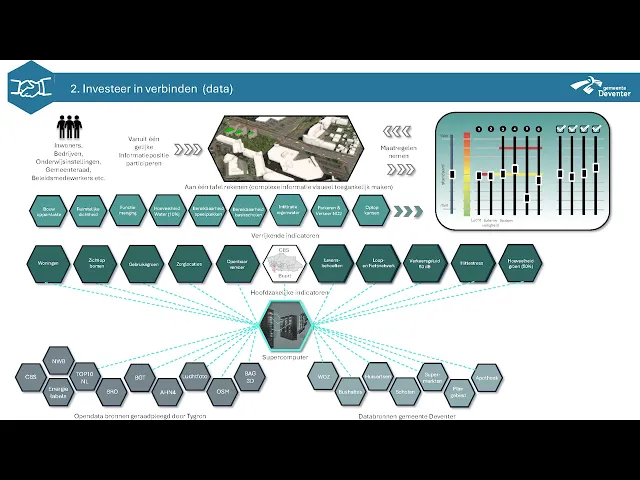
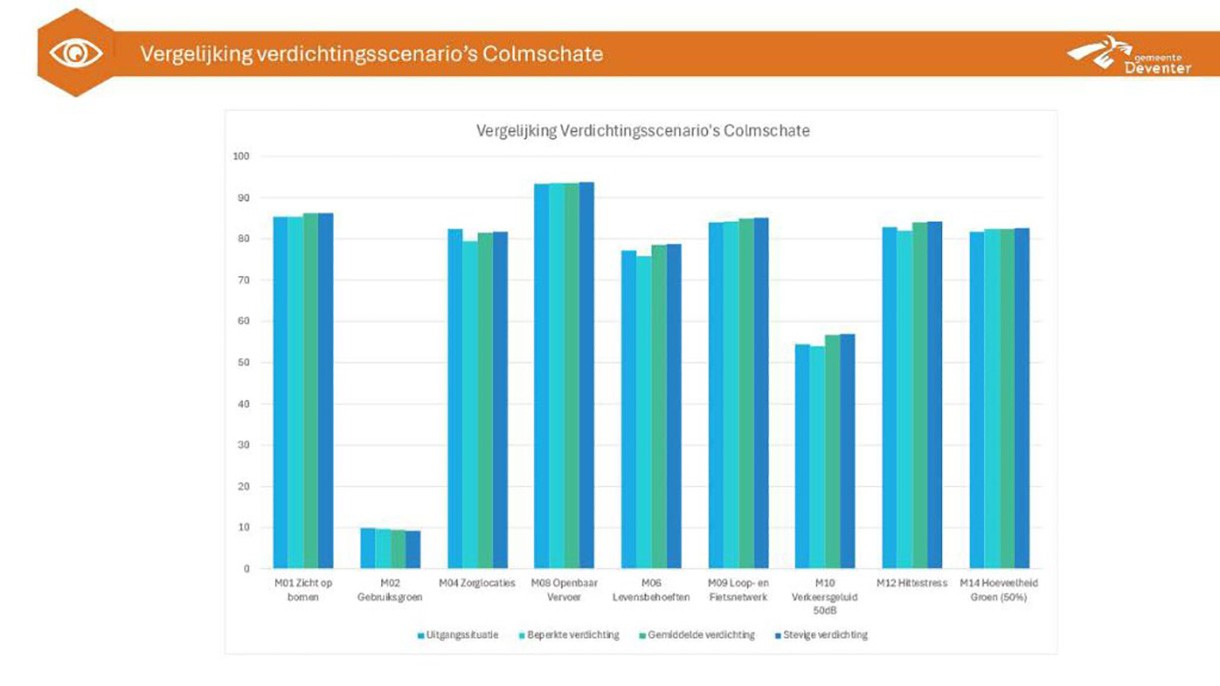
This created an iterative process in which policy content, data analysis, and design thinking were constantly aligned. And, not unimportantly, in which all those involved increasingly began to speak the same language. Two example areas around Colmschate station and the city center were calculated. "We developed indicators to compare strategies," says Achtereekte. This allowed variants to be tested on themes such as densification, greening, livability, and mobility. The team explicitly built scenarios based on design rules and municipal boundary conditions.
Schulkes: "With those boundary conditions, we look at how the design can develop from there." The result was ultimately clear. Densification and greening go together perfectly. "This was also actually to show, hey, it is possible."
Approach
Digital twin of the municipality brings a solution
"We started testing digital tools to get a grip on our growth," says colleague Gijs Schulkes, Coordinator of the Geo-information department of the municipality of Deventer. The challenge is to make smart choices that unite mobility, livability, and climate adaptation within the constraints of limited space. A digital twin of the municipality provided a solution. Not so much as the solution to all problems, but as a strategic tool to make future developments insightful and therefore manageable. It was a bit of a gamble, Achtereekte admits. "We said to each other, we have three months." Three months to use a digital twin to prove that you can add housing in Deventer within the existing urban area while strengthening green spaces and facilities. "Let's draw a contour around the city and not build outside of it."
But also, without the city clogging up or the greenery disappearing. In other words, densification. But densifying where, how high, and with what impact? This is precisely what the digital twin is used for, as a kind of data-driven second opinion that gives policymakers an assessment of the consequences of their decisions. According to Schulkes, the internal motto was: "We'll just start and see where we end up." By using existing insights and datasets from previous Tygron projects in, for example, Nieuwegein and Utrecht, steps could be taken quickly. As the project progressed, it became clear that the digital twin could only be effective if different disciplines were actively involved.
Colleagues from urban planning, landscape, mobility, and climate adaptation joined the sessions, bringing knowledge and perspectives together. Achtereekte: "Each session became a bit fuller, because colleagues talked to each other about it and curious colleagues would join the next time. Between sessions, questions and ideas were discussed by phone or email, according to Schulkes: "We were constantly approached. Can we spar with that colleague about this? Can we talk about this some more?"
This created an iterative process in which policy content, data analysis, and design thinking were constantly aligned. And, not unimportantly, in which all those involved increasingly began to speak the same language. Two example areas around Colmschate station and the city center were calculated. "We developed indicators to compare strategies," says Achtereekte. This allowed variants to be tested on themes such as densification, greening, livability, and mobility. The team explicitly built scenarios based on design rules and municipal boundary conditions.
Schulkes: "With those boundary conditions, we look at how the design can develop from there." The result was ultimately clear. Densification and greening go together perfectly. "This was also actually to show, hey, it is possible."
What has been modeled
GDO - indicators for healthy area development
Parking
Result
Discussion with the municipal council
The presentation to the council was tense. Reactions ranged from "A kind of Sim City, can I try it too?" to "Oh no, this really shouldn't get out, because it's going to go completely wrong." Ultimately, the project was enthusiastically received. In the meantime, the intention has been expressed to expand the project further. The lesson is clear. "Choose a pragmatic approach," emphasizes Schulkes. "Break it down into small pieces, because otherwise it simply becomes unmanageable." And Achtereekte adds: "You need an occasion and urgency to quickly get colleagues in the right mindset." Three months turned out to be exactly enough time in Deventer to go from skepticism to "shall we do a follow-up on this?"
Result
Discussion with the municipal council
The presentation to the council was tense. Reactions ranged from "A kind of Sim City, can I try it too?" to "Oh no, this really shouldn't get out, because it's going to go completely wrong." Ultimately, the project was enthusiastically received. In the meantime, the intention has been expressed to expand the project further. The lesson is clear. "Choose a pragmatic approach," emphasizes Schulkes. "Break it down into small pieces, because otherwise it simply becomes unmanageable." And Achtereekte adds: "You need an occasion and urgency to quickly get colleagues in the right mindset." Three months turned out to be exactly enough time in Deventer to go from skepticism to "shall we do a follow-up on this?"
"
“Each session became a bit more crowded, because colleagues told each other about it and curious colleagues then joined in the next time.”

Margriet Achtereekte
Municipality of Deventer
"
“Each session became a bit more crowded, because colleagues told each other about it and curious colleagues then joined in the next time.”
Margriet Achtereekte
Municipality of Deventer