Within the Digital Twins as a Common Good (DTa-CoGo) project, we collaborated on a practical case study for European Data Spaces. Together with municipalities and model builders, we investigated how Data Spaces can be applied in practice within an Open Urban Platform. The goal was to share datasets and calculations in a secure, scalable, and transparent manner.

Scalable and transferable
More information about DT-aCoGo: https://www.ds4sscc.eu/dtacogo
The Tygron Platform offers extensive options for data exchange. Within this project, we wanted to go one step further by making Tygron available as a calculation module, so that external parties can perform calculations without knowing the internal workings of the platform. The emphasis was on the heat stress module, an increasingly relevant theme for climate-resilient urban development.
More information about Tygron’s heat stress calculation module:
https://support.tygron.com/wiki/Heat_Stress_Module
Together with the calculation models of DAT.mobility for traffic and Rana for urban flooding, the participating municipalities (Rotterdam, Den Bosch and Tampere) can build a full Digital Twin using their own data. A specialized interface, developed by The People Group, brings models and data together in a single user-friendly environment.
The goal is not only this application, but above all a reproducible workflow that can also be applied by other cities, model providers and app developers.
The challenge
The Tygron Platform has a powerful API, but it closely aligns with the internal architecture. To use it effectively, specific knowledge of the platform is required. The challenge was therefore to make Tygron’s calculation power easily accessible to external applications.
As a basis, we used the existing open-source Tygron WebApp, which allows users to create Digital Twins, run calculation models and view results. Because this WebApp was designed for human users, a standardized API was needed for DTa-CoGo.
OGC API Processes
The OGC API Processes standard was chosen for the implementation, partly based on previous experiences and knowledge from Geonovum. This standard describes how processes are offered, started, tracked and how results are made available, both synchronously and asynchronously.
This allowed external applications to call processes in a standardized way and safely run long-running calculations in the background.
More information about the OGC API Processes standard: https://ogcapi.ogc.org/processes/
New API architecture
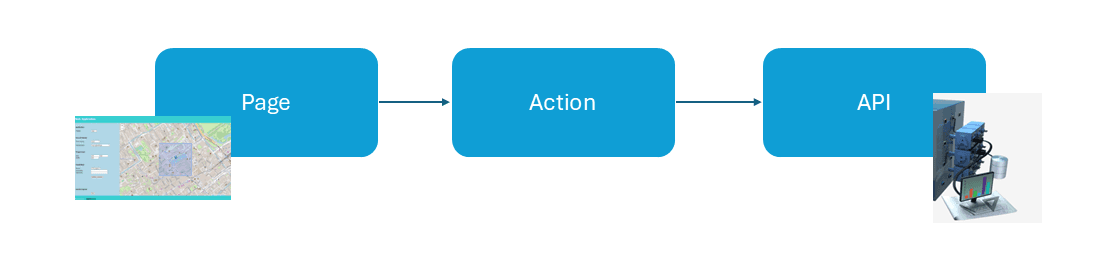
Instead of controlling the existing user interface via an API, a new architecture was chosen in which both the user interface and external applications use the same API. This keeps functionality better protected and aligns the architecture with Tygron's design principle: everything that can be done via the interface must also be available via an API.
Better performance without security risks
During the project, it turned out that the original processing of calculations did not scale sufficiently when requests came indirectly from other applications.

Therefore, the processing has been set up more smartly. Authentication errors are immediately caught with a temporary lock, so that repeated failed requests do not cause blocks. In addition, consecutive process steps are executed directly as much as possible until a waiting time is necessary. This has significantly reduced the total processing time of a job.

Authentication and contexts
Authentication also required a new approach. A shared account would mean that organizations could see each other's projects and results, while individual Tygron accounts introduced new management and security issues.
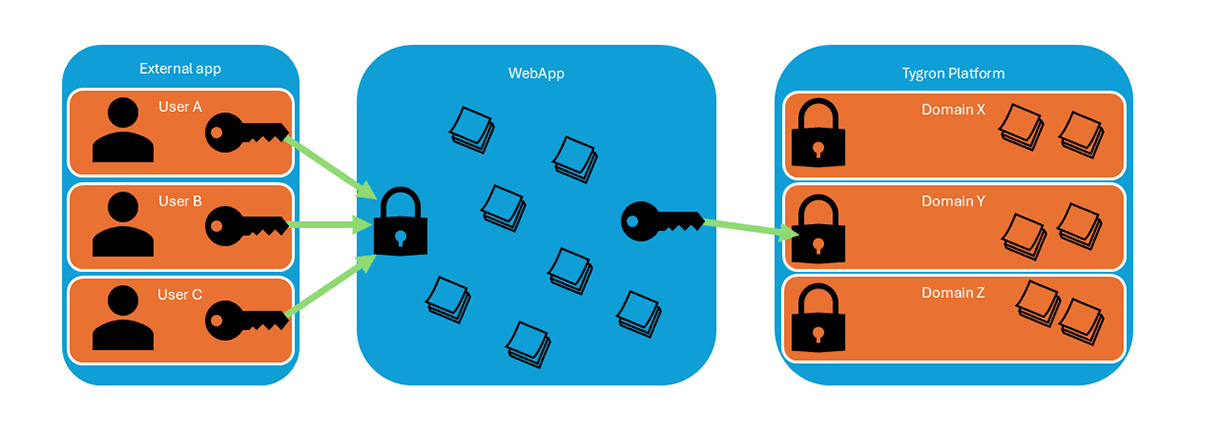
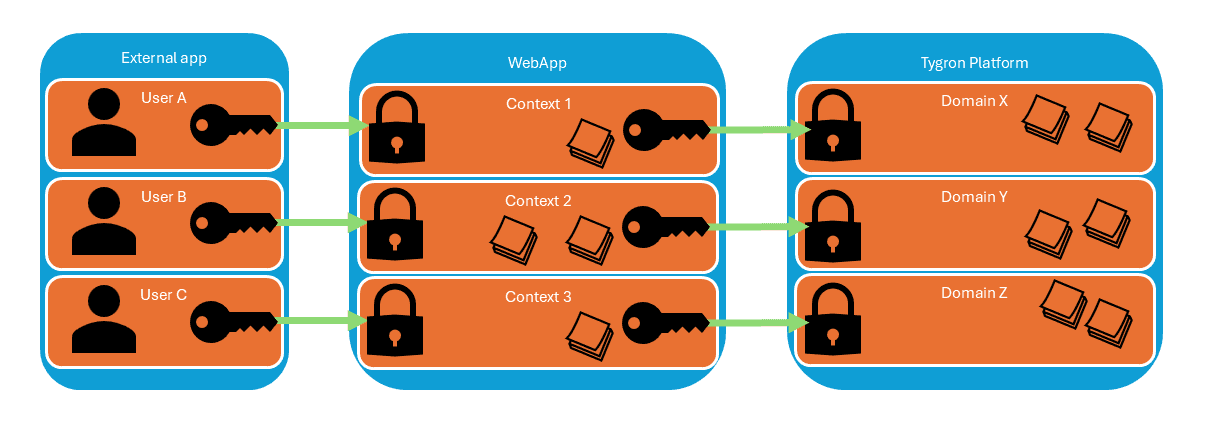
Therefore, the implementation of contexts was chosen. External parties authenticate themselves with their own token towards the WebApp. Each context then has its own configuration and Tygron credentials. This keeps organizations separated, manages jobs per context and creates a solid foundation for future user and access management.
Deliberate choices in the implementation
Although the API is based on the OGC API Processes standard, only the necessary components were implemented within the project. External applications can discover processes, start jobs, track progress and retrieve results.
Tests by both the developing partner and other technical partners yielded valuable feedback. Enhancements such as more comprehensive schemas, additional documentation and further separation of authentication are on the roadmap, but were outside the scope of this project.
Result
The application is now live for the organizations involved. The application developed by The People Group can automatically call the heat stress module of the Tygron Platform via the Open Urban Platform and present results to end users.
Furthermore, the approach developed is reproducible. Other municipalities, model providers and application developers can use the same standardized functionality.
In addition, most improvements have now been incorporated into the core of the WebApp, meaning that future applications will also benefit from better performance and extensibility.
Get started yourself
Do you want to get started with the WebApp, the API intermediate layer or the DTa-CoGo implementation yourself? The code is available on the Tygron GitHub under an MIT license:
https://github.com/Tygron/php-tygron-webapp
The functionality for DTa-CoGo is available as an included sample.

